My Region
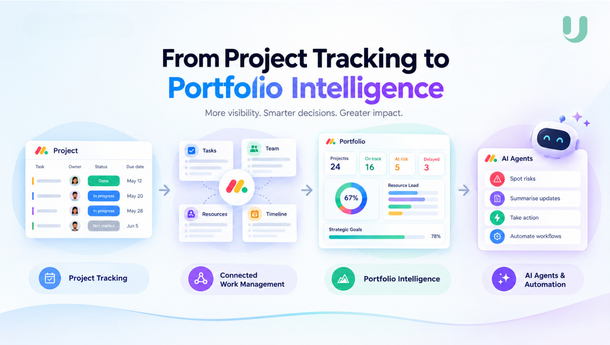
From Project Tracking to Portfolio Intelligence: The Evolution of monday.com
Today, that question is no longer enough. Business leaders also need to know why work is slowing down, where resources are being stretched, and which projects could affect wider business goals.
This shift is changing the role of platforms such as monday.com. What began as a flexible way to organise and track work has evolved into a broader work management platform. It now brings together project execution, portfolio visibility, automation and AI capabilities.
The rise of AI for project management is accelerating this change. monday.com is moving beyond helping teams record work. Its current direction focuses on helping teams understand work, predict risks, and increasingly automate actions.
The first stage: Project tracking
Traditional project management software largely focused on visibility.Teams needed a central place to record:
- Tasks and deadlines
- Project owners
- Milestones
- Dependencies
- Status updates
- Project documentation
The goal was straightforward. Give everyone a shared view of project progress.
This remains an important part of monday.com work management. Teams can build boards around their processes and connect projects, tasks, timelines, and dashboards.
However, tracking alone has a limitation.
A project board can tell you that a milestone is delayed. It does not automatically explain the wider consequences of that delay.
That is where modern work management starts to move beyond basic project tracking.
From project management to connected work management
As organisations grow, projects rarely operate in isolation.A product launch may depend on marketing, sales, finance and technology teams. A delay in one area can create problems across several others.
This makes connected visibility increasingly important.
monday.com has expanded its capabilities around project management, resource management, portfolio management and goals. Its enterprise offering now includes these capabilities within its broader work management platform.
Instead of looking at individual projects separately, leaders can connect projects and programmes to a wider business view.
For example, a portfolio dashboard could help a leadership team see:
- Which projects are progressing as planned.
- Which initiatives are facing risks.
- Where resources are becoming constrained.
- How projects connect to strategic goals.
- Where management attention may be required.
The result is a shift from “What is happening?” to “What does this mean for the business?”
The rise of portfolio intelligence
Portfolio management adds another layer of decision-making.
Imagine an organisation managing 30 active projects. Reviewing every project manually would take significant time.
A portfolio-level approach can bring key information together. Leaders can then focus on exceptions instead of reviewing every task.
monday.com describes its portfolio capabilities as connecting projects, programmes, resources, timelines, and goals. Its portfolio tools also provide higher-level views while allowing teams to maintain detailed project information underneath.
This creates a useful structure:
Individual tasks → Projects → Programmes → Portfolio → Business strategy
That structure matters because project success is not always the same as business success.
A project can finish on time while still delivering limited strategic value. Portfolio intelligence helps decision-makers consider the bigger picture.
Where AI for project management changes the equation
The next step is adding intelligence to the information already inside the platform.
AI can help with tasks such as:
- Summarising project updates
- Identifying potential risks
- Analysing project information
- Generating reports
- Supporting resource decisions
- Turning unstructured information into actionable work
monday.com describes three broad AI layers in project management: predictive AI, generative AI, and agentic AI. Each addresses a different part of the project lifecycle.
For example, generative AI can help create or summarise information.
Predictive capabilities can help identify potential risks.
Agentic AI goes further by allowing systems to monitor conditions and take defined actions.
This distinction is important because AI is not simply another reporting feature. It can increasingly become part of how work gets executed.
monday.com AI agents: From insight to action
One of the biggest developments in the monday.com ecosystem is monday.com AI agents.Traditional automations generally follow predefined rules. For example:
When a status changes to “Done”, notify the project manager.
AI agents can operate differently. They can use context, defined priorities, and available information to determine what action should happen next.
monday.com states that its AI agents can monitor work, make decisions within defined boundaries, and execute tasks across boards and workflows. They also operate with permissions and guardrails.
Consider a project portfolio with several delayed dependencies.
An agent could monitor those dependencies, identify potential risks, and escalate relevant issues. Instead of waiting for a project manager to discover the problem during a weekly review, the issue can be surfaced earlier.
This is where project management begins moving towards continuous project intelligence.
Why implementation matters as much as the platform
The more capable a platform becomes, the more important implementation becomes.Poorly structured workflows can create poor data. Poor data can then lead to unreliable reporting and limited AI value.
This is where working with an experienced monday.com partner can help.
A partner can support areas such as:
- Workflow design
- Workspace architecture
- Automations
- Integrations
- Data migration
- Training
- Ongoing optimisation
- AI implementation
As an Australian monday.com Platinum Partner, upstream supports businesses with implementation, workflow automation, training, custom development, and ongoing optimisation.
The objective should not be to implement every available feature.
It should be to build a system that reflects how the organisation actually works.
The future: From managing work to intelligent execution
monday.com has also been recognised as a Leader in Gartner's 2025 Magic Quadrant for Adaptive Project Management and Reporting and Collaborative Work Management. monday.com reported having approximately 245,000 customers in September 2025.These developments point towards a broader change in how businesses may use work management platforms.
The platform is no longer simply a place where people update task statuses.
It can become a connected layer where teams:
- Plan work
- Execute projects
- Monitor performance
- Identify risks
- Understand portfolio health
- Automate repetitive processes
- Use AI to support decisions
- Deploy agents for defined workflows
For business leaders, the real opportunity is therefore not simply using monday.com.
It is creating a work environment where information flows from execution to decision-making with less manual coordination.
Conclusion
The evolution of monday.com reflects a wider shift in project management.Teams once needed software to track work. Then they needed platforms to connect work. Now, they increasingly need systems that can interpret work and help act on it.
AI for project management is accelerating this transition. With portfolio visibility, predictive capabilities, and monday.com AI agents, the focus is moving from retrospective reporting towards more proactive management.
But technology alone is not enough.
Businesses need well-designed workflows, reliable data, and a practical implementation strategy. The right monday.com partner can help turn these capabilities into a system that supports real business outcomes.
Ready to move beyond basic project tracking? Talk to upstream about designing a smarter monday.com work management environment for your Australian business.
Frequently Asked Questions
What is monday.com work management?
monday.com work management is a flexible platform for planning, tracking, and managing work across teams. It supports projects, workflows, resources, goals, dashboards and automation.
How does AI for project management work?
AI for project management can analyse project information, summarise updates, identify risks, support planning, and automate certain activities. Its role depends on the capabilities and configuration of the platform.
What are monday.com AI agents?
monday.com AI agents are AI-powered workers that can monitor information, make decisions within defined boundaries, and execute tasks. They can operate across boards and workflows with permissions and guardrails.
Can monday.com support portfolio management?
Yes. monday.com provides portfolio management capabilities that connect projects, programmes, resources, timelines, and goals. This can give leaders a higher-level view across multiple initiatives.
Why work with a monday.com partner?
A monday.com partner can help with workflow design, implementation, integrations, training, automation, and optimisation. This can help businesses configure the platform around their actual processes rather than adopting a generic setup.